


Updated October 2026. NRV values checked on legislation.gov.uk and V80 label figures checked on vavaverve.com on 22 October 2026. Verve makes Transparent Greens V80, the example used near the end.
NRV stands for nutrient reference value. It is a fixed amount of a vitamin or mineral, set in law, that UK food and supplement labels use as a yardstick. The %NRV column tells you how much of that amount one serving or daily dose gives you: 100% NRV of vitamin C means 80mg. NRVs are a labelling reference for an average adult. They are not your personal target and they are not upper limits. A product needs at least 15% of the NRV before it can call itself a source of that nutrient or use a health claim for it.
The short answer
- NRV means nutrient reference value. The values are set in Annex XIII of Regulation (EU) No 1169/2011, kept in GB law.
- %NRV is your share of that value. 40mg of vitamin C is 50% of the 80mg NRV.
- It is a reference, not a target. NHS daily amounts for adults can be higher or lower.
- 15% is the line that counts. Below it, a product cannot claim to be a source of the nutrient or use a health claim for it.
- Over 100% is allowed. The NRV is not a ceiling. Live cultures, botanicals and collagen have no NRV, so they are listed in mg or CFU.
What %NRV on a label shows
The figure is simple maths: the amount in the product, divided by the NRV, times 100. Food labels give vitamins and minerals per 100g or 100ml, and may also give them per portion.
Supplements work differently. By law, a supplement label shows each vitamin and mineral per recommended daily dose, as an amount and a %NRV. If the daily dose is two tablets, one tablet gives half of every figure.
Amounts are in milligrams (mg) or micrograms (μg). See what μg means on vitamins.
Where NRVs come from
NRVs are in Annex XIII, Part A, of Regulation (EU) No 1169/2011 on food information to consumers. It has applied since 13 December 2014, and Great Britain kept the same values after Brexit. Every brand uses the same numbers, so labels can be compared. A few of them:
| Nutrient | NRV | 15% of the NRV |
|---|---|---|
| Vitamin A | 800μg | 120μg |
| Vitamin C | 80mg | 12mg |
| Vitamin D | 5μg | 0.75μg |
| Vitamin K | 75μg | 11.25μg |
| Vitamin B12 | 2.5μg | 0.375μg |
| Calcium | 800mg | 120mg |
| Magnesium | 375mg | 56.25mg |
| Iron | 14mg | 2.1mg |
| Zinc | 10mg | 1.5mg |
| Iodine | 150μg | 22.5μg |
A labelling reference, not a personal target
An NRV is one number for adults in general. It is not adjusted for age, sex, pregnancy, diet or health.
NHS daily amounts can differ. The NHS says adults aged 19 to 64 need 40mg of vitamin C a day, half the NRV. For vitamin D it is the other way round: the NHS says adults need 10μg a day, and the NRV is 5μg. For what you need, ask a GP or pharmacist.
The 15% rule: when a nutrient counts
Annex XIII also sets what counts as a "significant amount" of a vitamin or mineral:
- 15% of the NRV per 100g or 100ml, for foods other than drinks
- 7.5% of the NRV per 100ml, for drinks
- 15% of the NRV per portion, if the pack holds a single portion
Food supplements are judged on the recommended daily dose.
This decides which claims a product can make. "Source of" needs at least a significant amount, and "high in" needs twice that, so 30%. Authorised health claims for vitamins and minerals carry the same condition: the food must be at least a source of that nutrient. So "vitamin C contributes to the reduction of tiredness and fatigue" needs at least 12mg of vitamin C a day in a supplement.
A label listing 20 nutrients at 3% each looks busy, but none counts as a source. Read the %NRV column, not the length of the list.
Why some products show more than 100%
The NRV is not a ceiling. A 500mg vitamin C tablet is 625% of the NRV. A 25μg vitamin D supplement is 500%.
Safety has its own guidance. The NHS says less than 1,000mg of vitamin C from supplements a day is unlikely to cause any harm, and not to take more than 100μg (4,000 IU) of vitamin D a day. Add up every supplement and fortified food you take. By law, supplement labels must warn you not to exceed the stated daily dose.
Nutrients with no NRV
Only 13 vitamins and 14 minerals have NRVs. Everything else is listed by weight or count, with a dash or "NRV not established" in the %NRV column:
- Live cultures in CFU (colony forming units), often in billions.
- Botanicals and extracts in mg. "4:1 extract 125mg (eq. to 500mg)" means 125mg of extract made from 500mg of the plant.
- Collagen in mg or grams of peptides.
- Fibre, creatine and caffeine in g or mg.
No NRV just means no legal reference value. Compare these by amount and form.
NRV, RDA and RI: what is the difference
- NRV is the reference for vitamins and minerals (Annex XIII, Part A).
- RDA, recommended daily allowance, is the older term from the directive the 2011 regulation replaced. Old labels and websites still use it for the same idea.
- RI, reference intake, covers energy and macronutrients (Annex XIII, Part B): 8,400kJ/2,000kcal, 70g fat, 20g saturates, 260g carbohydrate, 90g sugars, 50g protein and 6g salt. A label giving %RI must add "Reference intake of an average adult (8 400 kJ/2 000 kcal)".
How to read a supplement table: a worked example
This is an example label, not a real product.
| Per daily dose (2 tablets) | Amount | %NRV |
|---|---|---|
| Vitamin C | 40mg | 50% |
| Vitamin D | 10μg | 200% |
| Zinc | 1mg | 10% |
| Spirulina | 500mg | - |
- Check the dose line. These figures are for two tablets.
- Read amount and % together. 40mg of vitamin C is 50% of 80mg.
- Look for 15%. Vitamins C and D are well over it. Zinc, at 10%, is not, so no zinc claim is allowed.
- Count your total. 10μg of vitamin D is 200% of the NRV and matches the NHS daily amount. Add it to anything else you take.
- A dash means no NRV. Compare spirulina by mg.
What V80 shows on its label
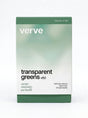
Transparent Greens V80 is Verve's daily greens powder. Its label table lists its ingredients with the dose per 10g serving, and a %NRV wherever one exists. A few rows, as they appear:
| Ingredient | Per 10g serving | NRV% |
|---|---|---|
| Vitamin C [as Ascorbic Acid] | 80mg | 100% |
| Vitamin D3 [as Cholecalciferol] | 5μg | 100% |
| Vitamin B12 [as Cyanocobalamin] | 2.5μg | 100% |
| Zinc [as Zinc Citrate] | 10mg | 100% |
| Chromium [as Picolinate] | 28μg | 70% |
| Magnesium [as Magnesium Citrate] | 56.25mg | 15% |
| Spirulina | 800mg | - |
| Lactobacillus rhamnosus | 4 billion CFU | - |
All 13 vitamins are at 100% NRV. Zinc is at 100%, chromium 70% and phosphorus 16%, with potassium, calcium, magnesium, manganese and copper at 15% each. Magnesium sits exactly on the 15% line. Vitamin D is half the NHS 10μg. There is no iron, and no iodine is declared. The 8 billion CFU of live cultures and the botanicals show a dash.
Vitamin B12 contributes to the reduction of tiredness and fatigue. V80's 2.5μg is 100% of the NRV, well over the 15% that claim needs.
Contains vitamin A (retinol). Not recommended if you're pregnant or trying for a baby. Contains vitamin K and ginkgo. If you take warfarin or another blood thinner, check with your doctor first. V80 has 11mg of caffeine per serving, contains wheat grass and barley grass, and may contain traces of hazelnut and walnut. The full table is on the Transparent Greens V80 page.

featured in this article
80 ingredients, every dose listed, 28 sticks
From $145.60/month
Food supplements should not be used as a substitute for a varied, balanced diet and a healthy lifestyle.
NRV in vitamins: your questions
What does NRV stand for on vitamins?
Nutrient reference value: the amount of each vitamin and mineral that UK labels use as a reference, set in law. %NRV shows how much of it a serving or daily dose gives you.
Is 100% NRV enough?
Not always. It is a reference for an average adult, not your personal need. 100% NRV of vitamin D is 5μg, while the NHS says adults need 10μg a day.
Is it safe to take more than 100% NRV?
It depends on the nutrient and your total intake. The NRV is not an upper limit. NHS guidance is under 1,000mg of vitamin C from supplements a day, and no more than 100μg of vitamin D. Never exceed the daily dose on the label.
What is the difference between NRV and RDA?
RDA, recommended daily allowance, is the older label term for the same idea. NRV replaced it when the current labelling rules applied from 13 December 2014.
Why does my supplement show a dash instead of a %NRV?
That ingredient has no NRV. Only 13 vitamins and 14 minerals have one, so live cultures are listed in CFU and botanicals and collagen in mg.
How we checked
NRVs, the significant amount rule and reference intakes: Annex XIII and Articles 32, 53 and 55 of Regulation (EU) No 1169/2011 (UK version, legislation.gov.uk). Supplement labels: Food Supplements (England) Regulations 2003, regulation 6. Claim conditions: Regulation (EC) No 1924/2006 Annex and retained Regulation (EU) No 432/2012. NHS amounts: nhs.uk vitamin C and vitamin D pages. V80 figures: its vavaverve.com label table. All checked on 22 October 2026. Only GB-authorised health claims are used. Verve makes V80.