




Updated October 2026. NHS guidance, UK labelling rules and Verve label figures checked on 25 October 2026. Verve makes Pure Hydra and V80, which are mentioned near the end.
Magnesium citrate is magnesium bound to citric acid. It is one of the most common forms of magnesium in food supplements, alongside oxide, bisglycinate (often sold as glycinate) and malate. The NHS says adults need 300mg of magnesium a day (men) or 270mg (women), and that 400mg or less a day from supplements is unlikely to cause any harm. More than 400mg for a short time can cause diarrhoea. On a label, read the figure for the magnesium itself, not the weight of the whole compound, and the %NRV next to it. The NRV for magnesium is 375mg.
The short answer
- Citrate is one form of many. Others on UK labels include oxide, bisglycinate, malate and chloride.
- Absorption: in small studies cited by the US National Institutes of Health, citrate was absorbed more completely than oxide.
- NHS daily amounts: 300mg for men and 270mg for women.
- NHS upper guide: 400mg or less a day from supplements is unlikely to cause any harm.
- On the label: the mg figure is the magnesium itself. 15% of the 375mg NRV (56.25mg) is the minimum for a magnesium claim.
What magnesium is
Magnesium is a mineral found in food and drink. The NHS says a varied and balanced diet should give you all the magnesium you need. These are the only magnesium health claims allowed in Great Britain, word for word. A product can use them only if it is a source of magnesium. For a supplement serving, that means at least 15% of the NRV.
- Magnesium contributes to a reduction of tiredness and fatigue.
- Magnesium contributes to electrolyte balance.
- Magnesium contributes to normal energy-yielding metabolism.
- Magnesium contributes to normal functioning of the nervous system.
- Magnesium contributes to normal muscle function.
- Magnesium contributes to normal protein synthesis.
- Magnesium contributes to normal psychological function.
- Magnesium contributes to the maintenance of normal bones.
- Magnesium contributes to the maintenance of normal teeth.
- Magnesium has a role in the process of cell division.
Magnesium citrate and the other forms on labels
In a supplement, magnesium is always bound to another compound, and that gives the form its name. The list of forms allowed in UK food supplements has more than 20 magnesium entries. Citrate appears on it as "magnesium salts of citric acid".
| Form on the label | What it is | Magnesium by weight (about) |
|---|---|---|
| Magnesium citrate | Magnesium bound to citric acid | 11% to 16% |
| Magnesium oxide | Magnesium bound to oxygen | 60% |
| Magnesium bisglycinate (glycinate) | Magnesium bound to two molecules of glycine, an amino acid | 12% to 14% |
| Magnesium malate | Magnesium bound to malic acid | 12% to 16% |
The last column is our calculation from each chemical formula. Powders that hold water carry less magnesium, hence the ranges. You may also see chloride, lactate, carbonate, taurate and sulphate.
Does the form change how much you absorb?
The NHS does not compare forms. The US Office of Dietary Supplements (ODS), part of the National Institutes of Health, says forms that dissolve well in liquid are generally absorbed better. It reports small studies in which the aspartate, citrate, lactate and chloride forms were absorbed more completely than magnesium oxide and magnesium sulphate. It does not cover glycinate or malate, and we found no credible source comparing them with citrate, so we make no claim for those two.
How a label shows magnesium
UK supplement labels give each mineral per daily serving, in mg, with its %NRV. That figure is the magnesium itself, sometimes called elemental magnesium. The form goes in brackets: "Magnesium (as magnesium citrate) 56.25mg, 15% NRV".
Some product names give the weight of the whole compound instead, such as "magnesium citrate 1,000mg". At 11% to 16% magnesium, that is roughly 110mg to 160mg of magnesium. Read the nutrient table, not the pack front.
The %NRV is the mg figure divided by 375. 56.25mg is 15% and 150mg is 40%. More in our guides to what NRV means on a label and what ug, mg and μg mean.
How much magnesium adults need
| Figure | Amount | What it is |
|---|---|---|
| Men, 19 to 64 | 300mg a day | NHS daily amount |
| Women, 19 to 64 | 270mg a day | NHS daily amount |
| NRV | 375mg | The reference used on UK labels |
| From supplements | 400mg or less a day | NHS: unlikely to cause any harm |
The NRV is a fixed reference for labels, not a personal target. It sits above both NHS daily amounts.
Food sources of magnesium
The NHS names spinach, nuts and wholemeal bread. The ODS adds green leafy vegetables, legumes, seeds and whole grains, and says roughly 30% to 40% of the magnesium in food is absorbed.
| Food and portion | Magnesium | Share of the 375mg NRV |
|---|---|---|
| Pumpkin seeds, roasted, 28g | 156mg | 42% |
| Chia seeds, 28g | 111mg | 30% |
| Almonds, dry roasted, 28g | 80mg | 21% |
| Spinach, boiled, half a cup | 78mg | 21% |
| Black beans, cooked, half a cup | 60mg | 16% |
| Brown rice, cooked, half a cup | 42mg | 11% |
| Wholemeal bread, one slice | 23mg | 6% |
These are US figures from the USDA. UK foods differ, so use them as a guide.
Upper guidance and who should take care
- The NHS guide. 400mg or less a day of magnesium from supplements is unlikely to cause any harm.
- High doses. More than 400mg for a short time can cause diarrhoea. The NHS says there is not enough evidence on the effects of high doses taken for a long time.
- Add it up. Electrolytes, greens powders and multivitamins often contain magnesium. Total the mg figures.
- Kidneys. The ODS says the risk of too much magnesium rises when the kidneys do not work normally. If you have a kidney condition, ask your GP first.
- Medicines. Magnesium can reduce how well bisphosphonates and tetracycline antibiotics are absorbed. The ODS advises a gap of at least 2 hours. If you take regular medicine, ask your pharmacist.
Magnesium in Verve products
Two Verve products contain magnesium. Their label figures:
| Product | Serving | Magnesium (form on the label) | NRV |
|---|---|---|---|
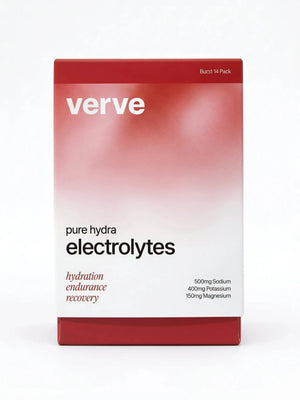
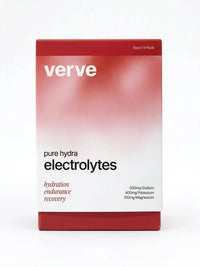
| Pure Hydra Electrolytes | One 6.7g stick | 150mg (as citrate, bisglycinate) | 40% |
| Transparent Greens V80 | One 10g stick | 56.25mg (as magnesium citrate) | 15% |
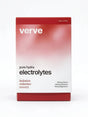
Pure Hydra gives 40% of the NRV per stick. Magnesium contributes to electrolyte balance. Each stick also has 400mg potassium, 200mg taurine and 100mg vitamin C. The label names both forms of magnesium but not the split between them. Each stick contains 500mg of sodium. If you are on a low-sodium diet or blood-pressure medication, check with your doctor before using it regularly. Contains coconut. The full table is on the Pure Hydra Electrolytes page.
V80 has 56.25mg of magnesium as magnesium citrate, exactly on the 15% line. It contains wheat grass and barley grass, may contain traces of hazelnut and walnut, and has 11mg of caffeine per serving from guarana. It contains vitamin A (retinol), so it is not recommended if you are pregnant or trying for a baby. It contains vitamin K and ginkgo: if you take warfarin or another blood thinner, check with your doctor first. If you also take a multivitamin, add the amounts together. See the Transparent Greens V80 page.
If you take more than one supplement with magnesium, add the mg figures together and keep the total at or under the NHS 400mg guide. Neither product is suitable for children. Keep out of reach of children. If you are pregnant, breastfeeding, taking medication or have a medical condition, check with your doctor first.

featured in this article
500mg sodium, 400mg potassium, 0.2g sugar
From $36.00/month
Food supplements should not be used as a substitute for a varied, balanced diet and a healthy lifestyle. Do not exceed the recommended daily intake.
Magnesium citrate: your questions
What is magnesium citrate used for?
It is used in food supplements and fortified foods to provide magnesium. Where a product gives at least 15% of the NRV, authorised claims can be used, such as "magnesium contributes to normal muscle function".
Is magnesium citrate better than magnesium glycinate?
We found no credible source that compares the two directly. The ODS reports small studies in which citrate was absorbed more completely than oxide, but it does not cover glycinate. Compare the mg of magnesium per serving and the %NRV instead.
How much magnesium citrate should I take a day?
Go by the magnesium, not the citrate. The NHS says men need 300mg a day and women 270mg, and that a varied diet should provide it. From supplements, 400mg or less of magnesium a day is unlikely to cause any harm.
Is it safe to take magnesium every day?
The NHS says 400mg or less a day from supplements is unlikely to cause any harm, but there is not enough evidence on high doses over a long time. Keep your total from all supplements at or under 400mg.
Which foods are highest in magnesium?
Seeds and nuts. On USDA figures, 28g of roasted pumpkin seeds has 156mg and 28g of almonds has 80mg. Spinach, beans and wholemeal bread add more.
How we checked
NHS figures are from the magnesium section of the nhs.uk vitamins and minerals page "Others" (last reviewed 3 August 2020). Health claims are from retained Regulation (EU) No 432/2012, the NRV and 15% rule from Annex XIII of retained Regulation (EU) No 1169/2011, and the permitted forms and labelling rules from Directive 2002/46/EC, all on legislation.gov.uk. Absorption, food figures (USDA FoodData Central), the kidney caution and medicine interactions are from the ODS magnesium fact sheet for health professionals. Verve figures and safety lines are from the Pure Hydra and V80 product pages. All checked on 25 October 2026. Verve makes Pure Hydra and V80.