



Updated October 2026. Verve makes a greens powder that contains barley grass, and we say where it fits near the end.
Barley grass is the young leaf of the barley plant, Hordeum vulgare, cut before the plant forms its grain. It is sold as a dried whole-leaf powder, as barley grass juice powder (juice pressed from the fresh leaves, then dried) and, less often, as fresh juice. Gluten is stored in the grain, not the leaf, but a crop can be contaminated with grain. So anyone with coeliac disease should go by a product's gluten testing, not the theory.
The short answer
- Barley grass is the leaf of the barley plant, picked young. It is not the grain you cook with or the grain in barley water.
- Whole-leaf powder is the dried, milled leaf. Juice powder is the pressed juice, dried, with most of the fibre taken out.
- On a label, look for the form, the dose in milligrams and a gluten-free statement backed by batch testing.
- This guide sticks to what barley grass is and what labels show. It makes no health claims for barley grass.
- Verve V80 contains 500mg barley grass per 10g serving and is gluten free by batch testing.
What barley grass is
Barley is a cereal crop, mostly grown for its grain. Barley grass is the same plant at an earlier stage: the green, leafy shoot, before the stem lengthens and the seed head forms. Pearl barley, malt and traditional barley water are made from the grain. Barley grass is made from the leaf.
In Japan, green drinks called aojiru are often made with young barley leaves. In the UK you mostly meet barley grass as a powder, on its own or in a greens powder. It tastes grassy.

featured in this article
80 ingredients, every dose listed, 28 sticks
From £60.00/month
How barley grass is grown and harvested
Most barley grass for powder is grown in fields and cut while the plant is still young and leafy, before the grain forms. That timing is relevant to gluten (more below). Smaller amounts are grown indoors in trays, as wheatgrass often is. After cutting, the leaves are cleaned, then either dried and milled into powder or pressed for juice.
Barley grass juice and powder: how each is made
The names sound alike, but the products are made differently.
| Form | How it is made | What is left in | How it mixes |
|---|---|---|---|
| Barley grass powder (whole leaf) | Leaves dried, then milled to a fine powder | The whole leaf, including its fibre | Can feel slightly gritty and settles if left to stand |
| Barley grass juice powder | Juice pressed from fresh leaves, then dried to a powder | The juice, with most of the fibre removed | Dissolves more readily in water |
| Fresh barley grass juice | Fresh leaves put through a juicer | The juice, not dried | Drink soon after making, as it keeps only briefly |
Because the pulp is thrown away, juice powder takes more fresh leaf to make each gram. Many labels just say "barley grass". If the form matters to you, ask the brand.
What barley grass contains
Like other leafy plants, barley grass is green because of chlorophyll. Published analyses also list dietary fibre, vitamins including A, B1, C and E, minerals including potassium, calcium and selenium, and plant compounds called flavonoids, including saponarin and lutonarin.
Amounts vary with variety, soil, harvest age and drying, so we have not given numbers. On a label, the only nutrient amounts you can rely on are the ones printed with a figure and a %NRV (nutrient reference value). If a vitamin or mineral is not listed, you cannot tell how much the barley grass provides.
Barley grass and gluten
The theory. Gluten is a group of proteins stored in the grain of wheat, barley and rye. In barley, the main one is called hordein. The leaf does not store these proteins, so barley grass cut before the seed head forms is not expected to contain gluten.
The practice. A crop can be cut late. Seeds can get mixed in at harvest. The same mill or packing line may also handle grain. Any of these can put gluten into a barley grass product. In 2015, Coeliac UK published a recall of a barley grass powder that was labelled gluten free but was found to contain gluten.
So the label and the testing matter more than the theory. In the UK, a food can only be labelled "gluten free" if it contains 20 parts per million of gluten or less. Barley is also one of the cereals containing gluten on the UK list of 14 allergens, so many brands emphasise barley grass in the ingredients list, often in bold.
A pack can show both: barley grass emphasised as an allergen and a "gluten free" statement. The emphasis tells you where the ingredient comes from. The gluten-free statement tells you the tested level in the finished product.
If you have coeliac disease, check that the product says it is gluten free, and ask the brand how it tests and how often. Verve V80 is gluten free by batch testing, with certificates available on request from hello@vavaverve.com. Wheatgrass raises the same question for the same reason.
How barley grass appears on labels
- The name. Barley grass, barley grass powder, barley grass juice powder, young barley leaf or Hordeum vulgare (leaf). All of these are the leaf, not the grain.
- The dose. A figure in milligrams or grams per serving. If barley grass sits inside a "blend" with one total weight, you cannot tell how much you are getting.
- The form. Whole-leaf powder or juice powder, if stated.
- Allergen emphasis. Often in bold, as a cereal containing gluten.
- Gluten free. A clear statement, ideally with a note that each batch is tested.
- Origin and testing. Where it was grown, whether it is organic, and whether the brand tests for heavy metals. Not every label says, but you can ask.
Our label-by-label comparison of UK greens powders sets out these facts side by side.
How people use barley grass
Most people shake the powder into cold water or fruit juice, or blend it into a smoothie with banana, pineapple or berries. If the taste is new to you, start with less than a full serving. Follow the daily amount on the label and do not go over it.
Barley grass in Verve V80
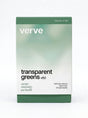
Verve Transparent Greens V80 contains 500mg barley grass in each 10g serving, alongside 500mg wheat grass, 500mg alfalfa, 500mg chlorella and 800mg spirulina. All 80 ingredients are listed with their doses, so no blend hides the amounts.
V80 does not rely on the grasses for its vitamin and mineral figures. These are added in stated forms and listed separately: all 13 vitamins at 100% NRV, zinc at 100%, chromium at 70% and phosphorus at 16%, plus potassium, calcium, magnesium, manganese and copper at 15% each, and selenium. There are also 8 billion CFU of live cultures (L. rhamnosus and B. bifidum, 4 billion each).
V80 is gluten free by batch testing, with certificates on request. It contains wheat grass and barley grass, and may contain traces of hazelnut and walnut. It is vegan, has 11mg caffeine per serving from guarana, and contains no iron. Every batch is independently tested for heavy metals. Take one 10g stick in 250 to 300ml of cold water a day.
Food supplements should not be used as a substitute for a varied, balanced diet and a healthy lifestyle.
Barley grass: your questions
Does barley grass contain gluten?
In theory no, because gluten is stored in the grain and barley grass is cut before the grain forms. In practice, grain can get into a crop or a factory. If you have coeliac disease, choose a product labelled gluten free (20 parts per million or less in the UK) and ask about its batch testing.
What is the difference between barley grass juice and barley grass powder?
Barley grass powder is the whole leaf, dried and milled, so it keeps the fibre. Juice powder is juice pressed from fresh leaves, then dried, with most of the fibre removed.
Is barley grass the same as wheatgrass?
No. They are the young leaves of two different cereal plants: barley (Hordeum vulgare) and wheat (Triticum aestivum). They are grown and dried in similar ways, and the gluten question is the same for both. Verve V80 contains both.
Is barley grass alkaline?
You will often see it called "alkalising". Your body keeps the pH of your blood within a narrow range by itself, whatever you eat or drink. Food does not change that, so we do not use the word.
Can I take barley grass every day?
If you take it as a supplement, follow the daily amount on the label and do not exceed it. Anyone pregnant, breastfeeding, taking medication or with a medical condition should speak to a doctor first.
How we checked
V80 figures come from Verve's own label (the nutrition and ingredients table on the V80 product page), read on 22 October 2026. The UK gluten-free threshold is from Coeliac UK's guide to gluten free labelling law. The 14 allergens and how they are emphasised are from Allergy UK. The 2015 recall is from Coeliac UK's news archive (12 August 2015). The compounds listed for barley grass come from the abstract of a 2018 scientific review in Oxidative Medicine and Cellular Longevity, used for composition only. Verve makes V80, which is named in this article.