


Updated October 2026. NHS guidance, UK labelling rules and V80 label figures checked on 25 October 2026. Verve makes V80, which is mentioned near the end.
Vitamin B1 is thiamin, one of the B vitamins. It is also spelt thiamine, and supplement labels often name the form, such as thiamine hydrochloride or thiamine mononitrate. The NHS says adults aged 19 to 64 need 1mg a day (men) or 0.8mg a day (women), and that you should be able to get all you need from your daily diet: peas, nuts, wholegrain bread, some fruit and fortified breakfast cereals are good sources. The body cannot store thiamin, so you need it every day. From supplements, the NHS says 100mg or less a day is unlikely to cause any harm. The UK label reference (NRV) is 1.1mg.
The short answer
- One nutrient, three names: vitamin B1, thiamin and thiamine. Labels often add the form, such as thiamine mononitrate.
- Daily amounts: 1mg a day for men and 0.8mg a day for women aged 19 to 64 (NHS). The NRV on UK labels is 1.1mg.
- Food first: peas, lentils and beans, nuts, wholegrain bread, oranges, bananas, eggs, fish and some fortified breakfast cereals all provide it.
- Needed every day: the NHS says the body cannot store thiamin.
- Upper guide: 100mg or less a day from supplements is unlikely to cause any harm (NHS). Heavy drinking can stop the body absorbing it: speak to a GP.
What vitamin B1 is
Your body can't make thiamin, so it has to come from what you eat. The NHS uses both spellings: thiamin on its vitamins pages, thiamine on its medicines pages. The authorised health claims use thiamine. It is the same nutrient.
Four health claims for thiamine are authorised in Great Britain. These are the exact wordings:
- Thiamine contributes to normal energy-yielding metabolism.
- Thiamine contributes to normal functioning of the nervous system.
- Thiamine contributes to normal psychological function.
- Thiamine contributes to the normal function of the heart.
The rules allow these claims only on food that is at least a source of thiamine.
The forms you see on labels
On a supplement label, the form of vitamin B1 usually follows the name in brackets. Four forms can appear on UK food supplement labels:
- Thiamine hydrochloride. Sometimes shortened to thiamine HCl.
- Thiamine mononitrate. The form in V80.
- Thiamine monophosphate chloride.
- Thiamine pyrophosphate chloride.
You will usually see one of the first two. The UK rules spell them thiamin hydrochloride and thiamin mononitrate. Labels often add the e.
How much vitamin B1 adults need
The NHS daily amounts for adults aged 19 to 64, with the UK label reference and the NHS upper guide for supplements:
| Figure | Amount a day | What it is |
|---|---|---|
| Men, 19 to 64 | 1mg | NHS daily amount |
| Women, 19 to 64 | 0.8mg | NHS daily amount |
| NRV | 1.1mg | The reference used for %NRV on UK labels |
| Supplements | 100mg or less | NHS: unlikely to cause any harm |
The NRV is a fixed figure set in labelling law so that products can be compared. It is not a personal target. A product at 100% NRV gives 1.1mg, a little more than either NHS daily amount. There is more on this in our guide to what NRV means on a label.
If you are pregnant or breastfeeding, ask your midwife or GP what applies to you. The NHS says thiamine can be taken in pregnancy and while breastfeeding, but only if your doctor has recommended or prescribed it.
Food sources of vitamin B1
The NHS lists these sources across its vitamin B and thiamine pages:
- peas, lentils and beans
- some fresh fruit, such as bananas and oranges, and orange juice
- nuts
- wholegrain breads
- some fortified breakfast cereals, and other foods with thiamin added
- eggs and fish
- yeast and beef extracts
- liver
The NHS advises avoiding liver if you are pregnant.
Why you need it every day
The NHS says thiamin cannot be stored in the body, so you need it in your diet every day. That is a reason to eat some of these foods each day, not on its own a reason to take a supplement.
How much is too much
The NHS says there is not enough evidence to know what the effects might be of taking high doses of thiamin supplements each day. The Department of Health and Social Care advises getting thiamin from a varied, balanced diet. If you take supplements, it says not to take too much, as this might be harmful. Its guide is that 100mg or less a day of thiamin from supplements is unlikely to cause any harm.
- Add up every product. Thiamin turns up in multivitamins, B complex tablets, greens powders and fortified foods. Add the mg figures together.
- Higher doses are a medical decision. Doctors sometimes prescribe more than 100mg a day. Follow your doctor if they do, but don't copy a prescribed dose on your own.
- Tests and scans. The NHS says thiamine can affect the results of certain tests. If you are due blood tests or scans, tell the doctor what you take.
Who may run low on vitamin B1
On alcohol, the NHS is clear: long-term drinking or heavy drinking can stop your body from absorbing thiamine. An NHS hospital leaflet for people who drink at high levels adds two more points. Alcohol can make you feel full and reduce your appetite, and it can affect how your body digests food and uses the nutrients.
If you drink heavily, eat a very limited diet, or think your thiamin may be low for any other reason, speak to a GP. Don't guess a dose. On the NHS, thiamine is also a prescription medicine, as tablets or as an injection usually given in hospital. A GP can decide whether you need it and how much. The NHS thiamine pages advise no more than 14 units of alcohol a week.
How vitamin B1 appears on a label
A typical supplement line reads: Thiamine (as thiamine mononitrate) 1.1mg 100%.
- The name. Vitamin B1, thiamin or thiamine. The form often follows in brackets.
- The unit. Thiamin is listed in mg, not μg. 1.1mg is 1,100μg. If the units are confusing, see what ug, μg and mcg mean.
- The %NRV. This is the amount divided by 1.1mg. So 0.55mg is 50% NRV, 1.1mg is 100% and 11mg is 1,000%.
- The column. Read the per serving figure, not the per 100g one.
Vitamin B1 in V80
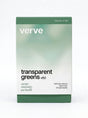
Transparent Greens V80 is Verve's daily greens powder, with all 80 ingredients listed on the label. Its vitamin B1 line is thiamine (as thiamine mononitrate), 1.1mg per 10g stick, 100% NRV. That is a little above both NHS daily amounts, and 1.1% of the NHS 100mg guide. Thiamine contributes to normal energy-yielding metabolism. V80 lists all 13 vitamins at 100% NRV, so if you also take a multivitamin or B complex, add the thiamin figures together.
V80 contains vitamin A as retinol (800μg), so it is not recommended if you are pregnant or trying for a baby. It also contains vitamin K (75μg) and ginkgo. Anyone on warfarin or another blood thinner should check with a doctor first. If you take another supplement with vitamin A, add the amounts together first. V80 has 11mg of caffeine per serving, contains wheat grass and barley grass, and may contain traces of hazelnut and walnut. The full table is on the Transparent Greens V80 page.

featured in this article
80 ingredients, every dose listed, 28 sticks
From $81.60/month
Food supplements should not be used as a substitute for a varied, balanced diet and a healthy lifestyle. Do not exceed the recommended daily intake.
Vitamin B1: your questions
Is thiamine the same as vitamin B1?
Yes. Vitamin B1, thiamin and thiamine are one nutrient with three names. Thiamine hydrochloride and thiamine mononitrate are forms of it used in supplements.
What does vitamin B1 do?
Four health claims for thiamine are authorised in Great Britain: "Thiamine contributes to normal energy-yielding metabolism", "Thiamine contributes to normal functioning of the nervous system", "Thiamine contributes to normal psychological function" and "Thiamine contributes to the normal function of the heart".
How much vitamin B1 do I need a day?
The NHS says 1mg a day for men and 0.8mg a day for women aged 19 to 64. The NRV on UK labels is 1.1mg. The NHS says you should be able to get all you need from your daily diet.
Which foods are high in vitamin B1?
The NHS lists peas, lentils and beans, nuts, wholegrain bread, oranges and bananas, eggs, fish, yeast extract and some fortified breakfast cereals. Liver is also a source, but the NHS advises avoiding it in pregnancy.
Can you take too much vitamin B1?
The NHS says there is not enough evidence to know the effects of high daily doses. Its guide is that 100mg or less a day from supplements is unlikely to cause any harm. Add up every product you take, and speak to a GP before going higher.
How we checked
NHS figures, food sources and upper guidance are from nhs.uk: the vitamin B page, the vitamins and minerals overview, and the thiamine medicines pages. The points on appetite and digestion are from the uhs.nhs.uk leaflet "Nutritional advice for people drinking alcohol at high levels or dependently". From legislation.gov.uk: the NRV from Annex XIII of retained Regulation (EU) No 1169/2011, the forms from Annex II of Directive 2002/46/EC, and the claim wording from Regulation (EU) No 432/2012. V80 figures are from its vavaverve.com label table. All checked on 25 October 2026. Verve makes V80.